
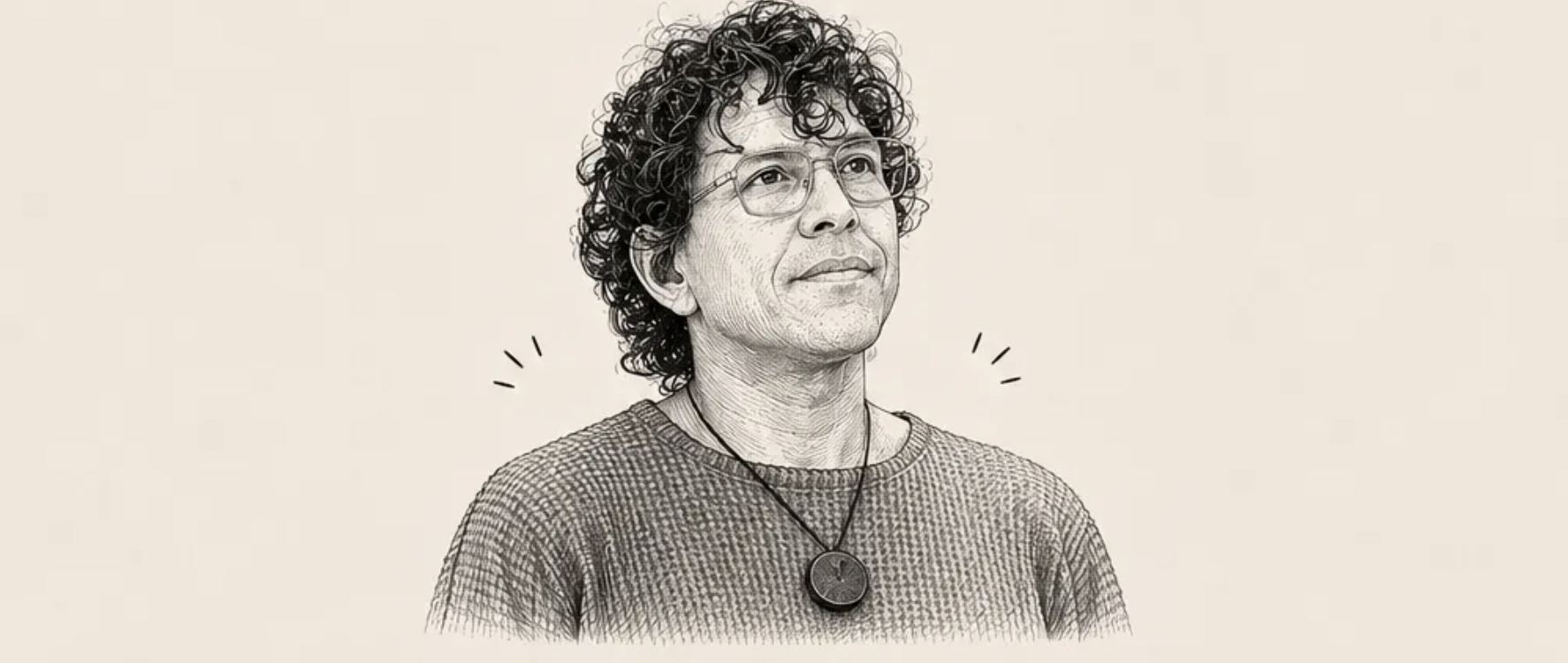
Eddie Arenas - Musician | Made in America
The following is the transcript of an interview between Sergio Muñoz and Eddie Arenas
Sergio: How do you identify?
Eddie: Chicano. Chicanismo has a strife. A way that you fought for your identity with a machete. I have a 6YO that is part me, part Michoacán, part Panamanian from his mother. We were just watching the World Cup. He was going hardcore for Mexico and Panama and he was distraught that England got both of them. England colonized his broken heart. I don’t know how my son is going to identify. Maybe a skater, maybe an Aries … he has it nice.
Sergio: Tell me about the house you lived in when you were 16YO?
Eddie: The house is off-green, suburban tract, post WW2, every fourth house is the same. Pico Rivera. I did the upward mobility route for Chicanos: moved from Pico-Aliso Projects in Boyle Heights to the suburbs. There is ample street parking and a driveway for two cars. There is a garage. There is a lawn, a ficus tree, a sidewalk, it’s a quiet street. The roof is pitched, one story, it has an interesting design where when you enter, all you see is the living room and all the demons are hidden from you. I lived there with my step-dad, my mom and my brother. Prior to this house, I grew up with a single mom and I was the man of the house and so when I moved in with my step-dad, there is a tension. It was struggle of authority. He grew up in East LA, went to Vietnam, came back on a GI Bill and went to UCLA. He was intimidating and I was scared shitless of him and he can out-do me with words because he studied philosophy. My mom had gone to Roosevelt Adult high school, ELAC, and was then trying to finishing up Cal State LA to fulfill her dream of becoming a teacher.
Sergio: What was expected of you at 16?
Eddie: That I get straight As, that I go to college. I was a good student. I ended up going to USC, I studied Urban Planning. At first, I wanted to be an architect, then a Civil Engineer. But too many dudes, too much science, too much math. I was a roquero. I was a heavy metal thrasher, the best guitar player in my high school. I had dreams of being a rock star but I was in East LA so I didn’t think it was possible to be a rock star. We were expected to get your shit together and get a degree and get a career. We had to silence our dreams.
Sergio: Were you MEChA?
Eddie: Absolutely. USC was 7% Latino. I felt super outcast. Growing up without a nuclear family, I was always resentful of the utopic suburban home. Everybody sitting around the table playing board games. The white students around me didn’t really work all that hard and they were getting As. I was the first in my family to do this and I was getting Cs. It was really something else. Being in MEChA was a savior. We could talk our language, eat our food, strut our strut, tell our jokes. I ended up also being a part of the Mexican American Alumni Association. They put me up as a bright star of my generation. They asked me to a gala dinner in Beverly Hills. I was not prepared for that dinner in the banquet room. I was in dockers without a belt. Everyone was in suits and tuxedos. I was lent a saco. I got recognition for my work in gentrification and the future of Boyle Heights. I got scholarships for that. I was studying mixed used urban environments. That became my thing in college.
Sergio: Were you a founder of Chicano Batman?
Eddie: Yes, we started Chicano Batman in 2008. The music business is rough. There is no certain path. I have had a lot of time to think about what it is, what it was and what it will be. Someone once asked me what the difference was between my band É Arenas and Chicano Batman: É Arenas is what I thought Chicano Batman was going to be. Chicano Batman was way bigger than I ever imagined. I was a City Planner at the time, I had health insurance, I had deferred comp and a match. A counselor told me to put in more, so much that you can feel the pinch. I remember him saying that.
Bardo approached me to play some songs during that time and I just thought that it would be whatever. I was the dude in the back with a beer. I was laid back. I was in a vulnerable space with people I don’t know and I’m a vulnerable person and I had a lot of barreras, I’m closed off to trust. I was very judgmental of environments. It continues to this day. That’s reality, that’s family, why these people were put into my life if life’s lesson itself. It was as random as a Craig’s List ad. We all were from different planets. It was destiny. It was hard to stay together because the needs of a relationship need to change, to fall apart, but we are raised to stay together. We sometimes have to do things that we don’t want to do. Pulling, leaving, other relationships, the fall back of dopamine.
Sergio: Tell me about the home where you currently live…
Eddie: There is a fig tree, a plum tree, artichokes, a grey wood fence. We have a hill in the back of Happy Valley / Lincoln Heights, coyotes sing in the evening, gallos in the morning. A beautiful sunset hits the rolling hills every afternoon. There is sage, bougainvillea covering the porch for shade and privacy. It is a white one-story duplex, of the century.
Sergio: Tell me your thoughts on prosperity….
Eddie: Prosperity is clear to me as: Peace of mind. Money doesn’t give you peace of mind. Income lets you buy cool things and services but peace of mind is the silence in the brain that doesnt feed off chaos. It was all chaos in my brain when I was younger. Through years in therapy, self-love has helped me work towards really loving myself in silence. Hope is tricky. As a musician, you need hope, financial management, accountability, good diet, good sleeping, if you don’t have those things, you might drag yesterday into tomorrow with no sense of progress. But hope doesn’t give you peace of mind. The natural vibration of your heart is important. If you find that, what you really love and value, you can get away from fear and envy. I think that is where I am right now. Our traumas perpetuate cycles of behavior in our lives and money can buy services for those traumas. Being mindful of my own needs and desires helped me wake up and stop living others peoples expectations of my future.
Sergio: Are you familiar with integration?
Eddie: I know that feeling, especially when I use to come back from tour. One night I can be playing for 7,000 adoring fans who treat us like kings and then I come home and I haven’t mopped in three months, I have ants now, I have to clean the dishes, I have to change dirty diapers? I would end up having nobody to talk to about this hard contrasting reality except my bandmates. The dopamine crashes and we try to keep it from doing that. I would turn to weed, to coffee, to burgers, lose sleep… The dopamine has to crash to below the baseline and it’s a scary feeling. It feels like depression, anxiety, loneliness, like a fish out of water. But you have to trust that it will go back up eventually. We aren’t used to letting feelings suck without trying to problem solve, to avoid, to distract….
Sergio: When did you start É Arenas?
Eddie: When my demos weren’t being picked up in Chicano Batman. I have a little gangster Eddie voice inside of me that i trusted for many years that would say, you dont need them, you dont need nobody. Growing up in Boyle Heights in the 80/90s the street really became part of our identity. My gangster Eddie voice kept framing things in a black/white drill sergeant way.
In between that all I had to coach myself into believing in my ideas making them a reality. All these songs were valuable to me so I just started doing it all myself. I realized that Chicano Batman wasn’t forever and I needed to have something to land on one day. Since 2017 i have been able to build a community that believes in my brand of music, develope a performance style, a narrative, and make use of my intense energy in a creative way. Ive done of ton of shows since, including a headlining show Noche de Cumbia at the Ford Ampitheater last year and just headlined Culture Clash’s 40th Anniversary show at Grand Performances in Downtown LA. Both shows were absolutely incredible. We energy that my band and the audience creates together is so electric and surreal. We are playing Mucho Gusto in Riverside next.
Sergio: How did you get hooked up with American Pachuco?
Eddie: The producer saw É Arenas. I had already helped on a documentary for PBS and so I was familiar with scoring. I’m a Chicano. I fit into the movie. Luis Valdez created a path for me. It wasn’t going to be cumbias and corridos, it was more about the emotional expression of Chicanos. I wanted to humanize the Chicano experience. I want people to feel what it’s like be in the campos, in the streets…. there is a scene where Connie Valenzuela is looking at Lou Diamond Phillips performing as her son and she’s weeping and I was weeping and I want people to understand what that was like through sound. My approach was to make the sound a generational bridge for the youth.
#Intelatin #Media #Music #EddieArenas #EArenas #ChicanoBatman
Sergio C. Muñoz is a Mexican banker writing on Latina/o Prosperity. His work has been featured in the US Hispanic Business Council; Caló, the Los Angeles Times, the OC Register, PBS, NPR, WNYC, Revista - Harvard Review of Latin America, Studio 360, Latino Leaders Magazine, Poder Hispanic, Sopitas, Animal Político & ¿México Cómo Vamos?
To support my work, please consider purchasing a sample of salt from our sponsor, Santa Prisca & Co: https://bit.ly/Intelatin
Explore More Stories From America’s Small Business Community: Made in America