
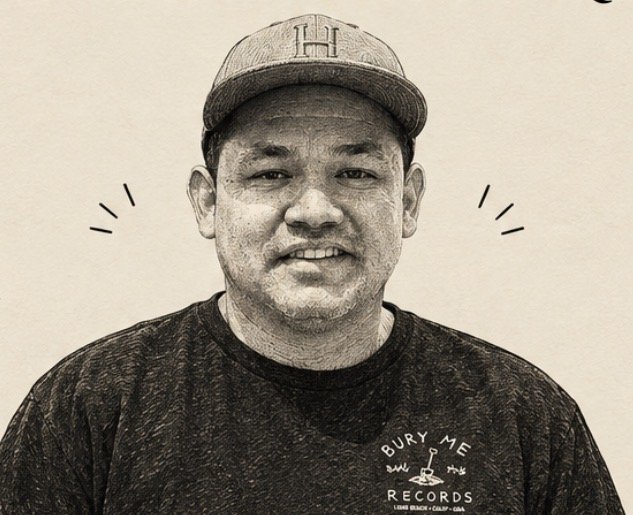
The following is the transcript of an interview between Sergio Muñoz and Victor Vasquez
Sergio: How do you identify?
Victor: Salvadoran, first generation American.
Sergio: Tell me about the house you lived in when you were 16YO?
Victor: I grew up in West Hollywood in one of those dingbat apartments like in the Slums of Beverly Hills movie. It was across the street from my elementary school. You could see the Hollywood Hills from the street. I lived there with my grandparents, my mom, sister, aunt, and roommates coming in and out. Prior to moving to West Hollywood, we lived in a very modest bungalow with an equally modest rent of just $150.00 a month. Moving to West Hollywood was a big upgrade, in terms of space and location, but the increase in rent was substantial. Definitely a family effort to make it possible
Sergio: Where did you situate yourself economically at 16?
Victor: I guess I would say we were somewhere in the middle class. We didn’t necessarily get everything we wanted, but we always had what we needed. At the time, I didn’t think much about our financial status because we never really went without. Looking back though, I realize we didn’t have many luxuries. We lived modestly, but we were comfortable and had the essentials.
Sergio: Were you already in skate culture?
Victor: Yeah, by 16 I was deep in the culture, and was fortunate to have a local shop sponsor prior to my high school years. I also had a tight circle of friends equally passionate for skateboarding.
Sergio: Was Bones Brigade active during this time?
Victor: Yes. I was exposed to the Bones Brigade at a very young age. The Future Primitive video released in 1985 had a huge impact on my skating. Thanks Tommy G! In those years, skate vids were difficult to attain. Only one copy existed in the neighborhood, and it was either passed around or we piled in a friend's living room to watch.
Sergio: What was expected of you at 18?
Victor: By the age of 18 my family could see that I was naturally drawn to video and photography, and more importantly to skateboarding. College wasn’t my priority. I wanted to get a job, keep skating and see where it would take me. That’s exactly what happened. I picked up a sales job at a local shop called Shut Up & Skate on the corner of La Brea and Melrose in L.A. The shop experience provided a ton of opportunities, and I'm super grateful for all of the people that helped me along the way.
Sergio: What happened next?
Victor: After Shut Up & Skate, I got a job at another local shop called Atomic Garage, Japanese owned. The shop specialized in skate, snow, and streetwear fashion. This is where I really got interested in retail and buying. I began tracking inventory and learning how to merch, along with light buying duties for skate hardgoods. I also built a lot of relationships during this time, both through the business and by going to trade shows. Many of the companies I was working with had been founded by skateboarders, so there was a natural connection and understanding on how the industry works.
One day working at Atomic, I met Mark Gonzales and Doug Diaz who were working on a skate video for Mark’s company 60/40 Skateboards. That led to an opportunity for me to help film their L.A based skate team. The project spanned 2 years at that point. Gained some filming experience working with 60/40, and opened a new opportunity later on to freelance as a videographer for Girl and Chocolate skateboards in the mid to late 90’s. I was able to do this while continuing to work part time at the shops. In 1999, the skate, surf, and snow industry was booming, and I decided to focus exclusively on my work in skate retail.
After Atomic in 1994, I had an amazing opportunity to become the skate hardgoods and softgoods buyer at Val Surf in the San Fernando Valley. If you’re not familiar, Val Surf was the first skateboard shop in the world, and at the time they had three stores. It was a much bigger operation, and it gave me an entirely new perspective on the business. Val Surf was also the first shop I bought my first quality board in 1986, so it was super special to join the Val family. I held that position for 24 beautiful years.
After Val Surf, I was recruited by Vans to manage their wholesale apparel business in southern California. That was another major jump from working with a large independent retailer to representing a heritage company doing roughly $2 billion in sales globally. I worked with Vans for nearly 8 years at the peak of the brand’s success, which was incredible. Presently, I’m a wholesale representative for Herschel Supply Co., Arbor Skateboards, and The Quiet Life.
Sergio: Tell me about the home where you live present-day?
Victor: I live in South L.A. just east of Leimert Park in a 1913 2-bedroom craftsman home. I have a modest little home with a ton of potential. Lots of palm trees nearby, quiet streets, great neighbors. The area is rich in culture and history. The location is ideal - 25 minutes east to Downtown L.A, 25 minutes west to the coast, close to all major sports venues.
#Intelatin #Media #Skateboarding #Merchandizing #VictorVasquez
Sergio C. Muñoz is a Mexican banker writing on Latina/o Prosperity. His work has been featured in the US Hispanic Business Council; Caló, the Los Angeles Times, the OC Register, PBS, NPR, WNYC, Revista - Harvard Review of Latin America, Studio 360, Latino Leaders Magazine, Poder Hispanic, Sopitas, Animal Político & ¿México Cómo Vamos?
To support my work, please consider purchasing a sample of salt from our sponsor, Santa Prisca & Co: https://bit.ly/Intelatin
Explore More Stories From America’s Small Business Community: Made in America