
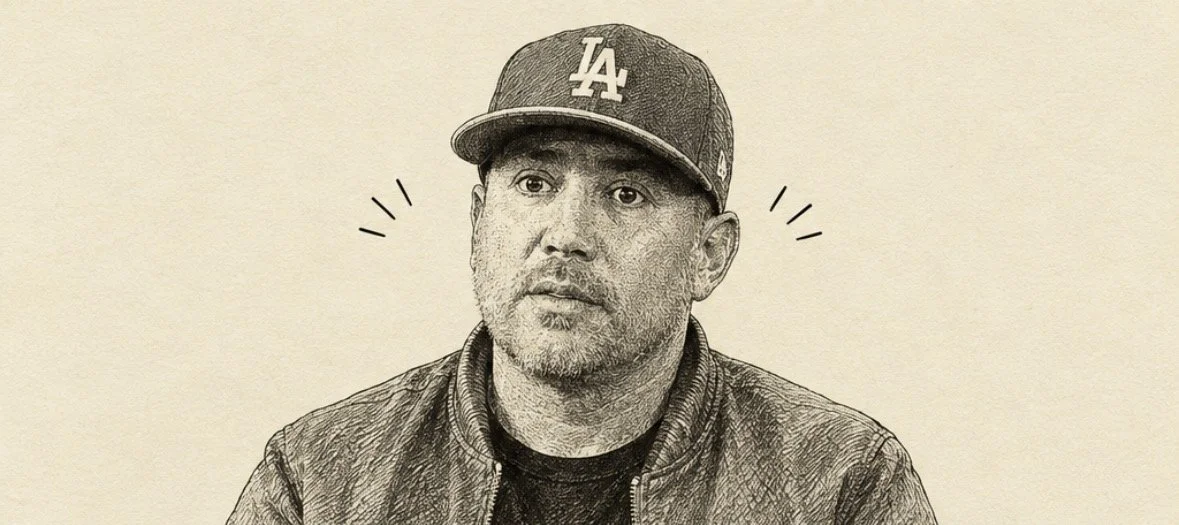
The following is the transcript of an interview between Sergio Muñoz and Edoardo Chavarín
Sergio: How do you self-identify?
Edoardo: I was born in Tijuana but I am an unlimited being living in a body at this time. I feel we are all part of this great energy, the source, la fuente, we are part of it living a physical experience in order to express ourselves. The more practical answer is that I am a Creative Director. I love to tell stories and I like to problem solve in a creative way.
Sergio: Describe your home when you are 16YO…
Edoardo: I grew up in a middle class family in Tijuana. Loving home, both parents and two brothers, with me in the middle. We have a white fence surrounding a small white three-bedroom house with burgundy accents. My parents still live there and my room is still there but the house has been remodeled. Good music, good food, lots of love. It was in Fracc: Monterrey on a hill, a colina, as kids we would only play on our block because if you tried to go up a block, it was uphill, if you went down, you had to get back up the hill, so we stayed on our block and played from 10am to 6pm.
Sergio: What was expected of you at 18?
Edoardo: I had graduated high school in Tijuana, and that part of life was okay—the usual teenager stuff, but okay. I was ahead of the curve in a career sense because I knew that I wanted to be a designer and work in the arts. I was always very creative. I was encouraged to study art, and I wanted to study art, so there was no tension there. I started at Southwestern College, just across the border, to put a portfolio together, and then went to ArtCenter College of Design in Pasadena. My parents were very supportive. It was a lot of hard work, but fun hard work. I had a goal.
Sergio: When did you graduate from Art Center?
Edoardo: 1999. I loved being there. I found my tribe. In high school, I was uninspired sometimes, like, why do I have to be in a chemistry class when all I want to do is draw? I did the minimum to get by but when I got to Art Center, I felt like I was home and I started to work really hard. I hustled for grants, I worked two jobs, as a private school, I really needed to hustle. They wanted us to dedicate ourselves completely to school but I couldn’t do that. I worked in the school art store to get a discount on supplies. I did everything I could to get my time there to work for me. What I learned along the way was that at Art Center, the currency was your talent. Your talent dictated the hierarchy.
Sergio: After you leave Art Center, you experience what all of us dream about when we dream of going viral. I am going to skip that part of your life because I know that you do lots of interviews where you talk about that successful period of your life. Where I would prefer to go is to Tijuana in 1994. I have a theory that March 23, 1994, is the single most critical day in the contemporary history of Mexico. It was on this day that the Presidential candidate for the PRI, Luis Donaldo Colosio, was killed in Tijuana. What can you tell me about that day and how that impacted you as a tijuanense?
Edoardo: I remember exactly where I was. I had just graduated high school in 93 and I was at my girlfriend’s house. Her mom was there and somebody called to tell us and the whole city, Tijuana, as well as the whole country, got paralyzed. It was as though you could hear a pin drop. Everybody was glued to the TV and it felt like Mexico got put on hold. I was still a teenager so I had a lot of mixed emotions. I know that I didn’t wish that kind of tragedy on anybody but I also thought that maybe this is the one thing that can get Mexico to react. Why is this one political party in power for seventy years? It’s like you want things to burn. There was a sense of: At least something is happening. At the same time, Colosio was somebody’s father and somebody’s son. And it happens in my city which doesn’t have the best reputation in the world. This doesn’t paint a beautiful picture of my city. I am not one that dives into politics at all. My way of trying to level things out is to have sensibility, to do good things, to be creative, to smile at the lady in the coffeeshop and I hope that tips the scale in the other direction. I want to be a part of the other side, the art, music, photography, poetry…. That moment changed us forever though.
Sergio: Tijuana was an interesting place for us because it was the one place where you were encouraged to have as much fun as possible. Rosarito, too. All you needed to do was to drive down through San Diego with your California driver’s license and all the rules went out the window when you got to Tijuana. I remember going to the restaurants near the Jai Alai to eat fried quesadillas with flor de calabaza and drink margaritas and it seemed like another world with good music, good food, so fun, no rules.
Edoardo: Carlos Santana described Tijuana as the cantina in Star Wars—folks from different galaxies gathered together in one place. I describe it as the place where your friend had the parents who were never home. Speaking of which, there was a place that, for me, formed my identity: a venue called Iguanas, very close to the border on the Tijuana side. I loved Iguanas. No rules. Nirvana, Jane’s Addiction, Pearl Jam, Nine Inch Nails, Björk, Soundgarden—everyone played there. I saw a few of those shows, and that place changed my life. I just wanted to be around that energy. In San Diego, it was 21 and over, but I could go to Iguanas at 16 with $10 and see so many incredible bands that I saw on MTV or read about in Ray Gun magazine. I started to dream that one day I would be part of that movement and be able to design records for these types of bands. The guard was changing at that moment, from Mötley Crüe and all the glam rock to this alternative rock movement, and I loved it. I also got to see Porno for Pyros at El Rancho Grande in Tijuana—a venue with a capacity of about 500 people, and about 5,000 people showed up. Amazing shows. It was mystical, it was interesting, it was rock and roll, it was beautiful.
Sergio: Describe your home present-day….
Edoardo: We live in the Studio City area in a normal three-bedroom, light grey house with my wife and our two children, on a nice street. We have a park around the corner, so there are always people walking through the neighborhood, walking their dogs, riding their bicycles. It’s peaceful and just a beautiful Los Angeles street in a nice community. We love it.
Sergio: What are you working on right now?
Edoardo: We are always working on a bunch of things at the same time. We’re working on a brand identity for an important family restaurant in Tijuana. I always make room for projects in Mexico, as well as my projects in the U.S. I’ve always thought of it as a superpower, being Bi-cultural having one foot in Mexico and one foot in The US. I can see both sides of the coin. We just started redesigning the brand identity for an iconic venue in Mexico City also, and after three years of work, we just finished producing a five-episode documentary series on the life of Mexican Champion Julio César Chávez that’s now playing on ViX, so we’re unwinding from that. Lots of stuff happening.
Sergio: Who is doing better, Edoardo at 16 or Edoardo present-day?
Edoardo: Are you kidding me? Edoardo today for sure!
Sergio: Do you have any thoughts on the concept of prosperity?
Edoardo: For work, I am always thinking of the future so through my meditation practice and my yoga practice, I bring myself back to enjoy the present. I also have a savings account for a rainy day.
Special thanks to Moisés Baqueiro for this intro to Edoardo.
#Intelatin #Media #USHBC #Entrepreneurs #NaCo #EdoardoChavarín #Tijuana #ArtCenter
Sergio C. Muñoz is a Mexican banker writing on Latina/o Prosperity. His work has been featured in the US Hispanic Business Council; Caló, the Los Angeles Times, the OC Register, PBS, NPR, WNYC, Revista - Harvard Review of Latin America, Studio 360, Latino Leaders Magazine, Poder Hispanic, Sopitas, Animal Político & ¿México Cómo Vamos?
To support my work, please consider purchasing a sample of salt from our sponsor, Santa Prisca & Co: https://bit.ly/Intelatin
Explore More Stories From America’s Small Business Community: Made in America